
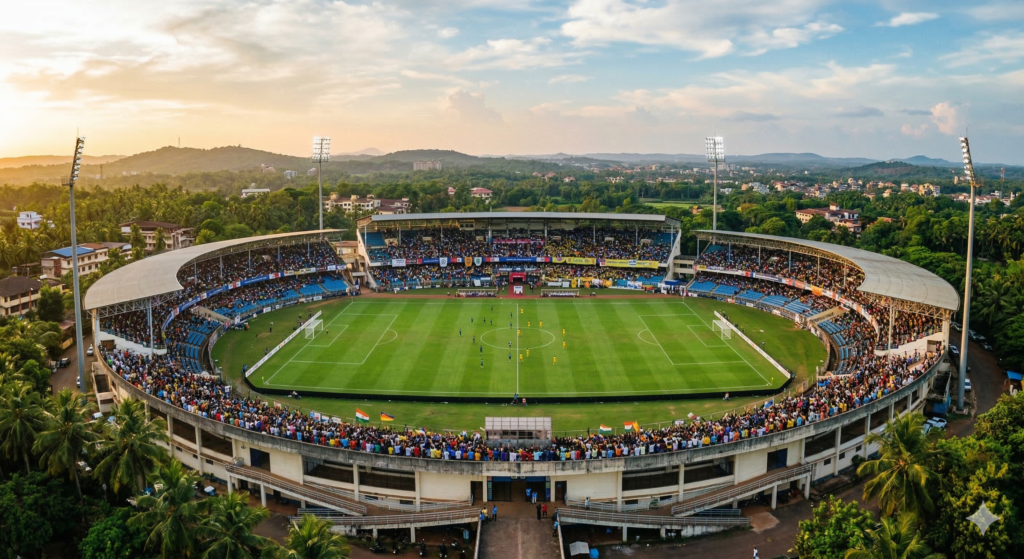
The first official football match in Goa was recorded in Panjim in 1900. By 1923, the state saw matches played between British Officers and Portuguese Amateurs. For nearly a century, the game was part of daily life for Goans, yet it was mostly played on open village commons and local dusty fields. Despite this passion, Goa lacked a professional home base or a proper venue where the global side of the sport could finally be portrayed and celebrated on a grand scale.
When Saudi giants Al Nassr visited Margao recently, or when Brazil and Germany played here during the U-17 World Cup, Fatorda stood as the ground for these significant encounters. From the first 1989 Nehru Cup to the AFC Champions League and the ISL (Indian Super League) Finals, this ground has become the place where Goan fans witnessed the biggest moments in the sport with this turf having seen some of the most significant matches in Indian football history.
For over thirty years, the Pandit Jawaharlal Nehru Stadium in Fatorda has served as the primary home for football in Goa. While it is now a familiar landmark in Margao, the story of its construction is an interesting look at how Goan sports infrastructure was established in a very short window of time.
The Decision for a Dedicated Stadium
For many years, the Goa Football Association (GFA) and the state government discussed the need for a full-fledged multipurpose stadium. Initially, land was identified in Bambolim, but work did not immediately begin.
The focus shifted toward Fatorda when Francisco Monte Cruz became the Minister for Sports. He prioritized the project, and the government eventually utilized land in Fatorda that was already earmarked for sports, along with additional area acquired from local tenants and the Chowgules. This created the 123,000sqm site that the stadium occupies today.
Design and Goals
The stadium was modeled after the Jawaharlal Nehru Stadium in New Delhi, which had been built for the 1982 Asian Games. To ensure the design was accurate, a team including the Sports Minister and PWD architect, Prakash Kamat traveled to Delhi to consult with the Sports Authority of India.
The primary goal for finishing the stadium quickly was to allow Goa to host the Nehru Gold Cup. Having seen the tournament successfully hosted in Siliguri, the Goan sports department wanted to ensure that the state had the facilities ready to host the next edition of this international event.
Construction Timeline
The foundation stone was laid on May 30, 1988, which coincided with Goa Statehood Day. Funding the project required coordination between the state government and the Planning Commission in Delhi. While there were initial challenges in securing the full amount, the state eventually allocated the necessary budget to keep the work moving.
The construction contract was awarded to the UP State Bridges Corporation, a company already working in Goa on the Mandovi bridge project. The work proceeded at a very fast pace, with teams often on-site from early morning until late at night.
Ultimately, the stadium was completed in 233 days. It was officially inaugurated on January 19, 1989, by then Vice-President Shankar Dayal Sharma, just in time for the opening of the Nehru Gold Cup.
A Lasting Venue
Built at an estimated cost of Rs 9.26 crore, the stadium was a significant investment for Goan sports at the time. In the decades since its inauguration, It has grown into a venue that holds national events, ranging from the competitive battles of I-League 2 to major international tournaments.Today, Fatorda remains the heart of the sport in the state. Its history serves as a record of a specific period in Goan sports development when a major facility was planned and delivered within a single year.