
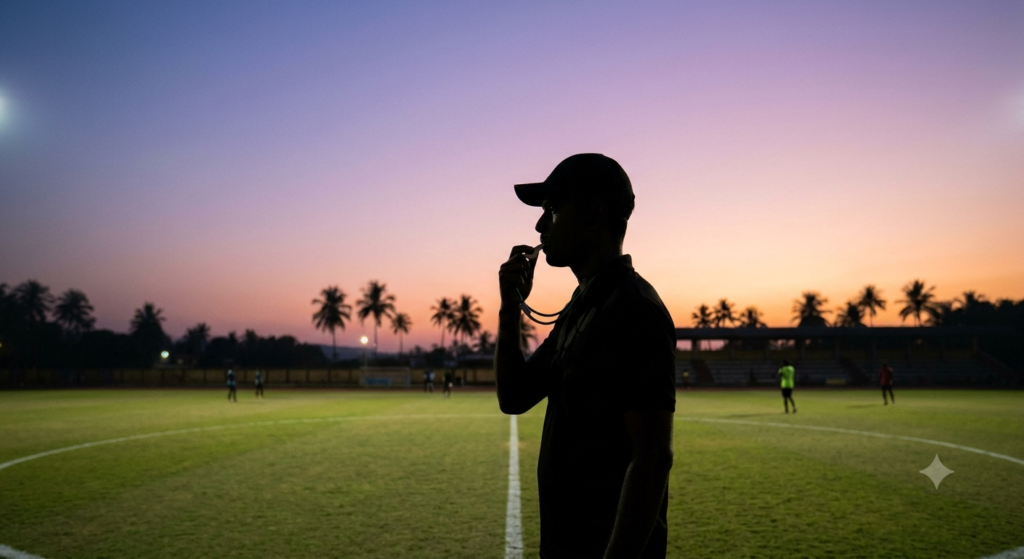
A football match has twenty-two players and one person who keeps the whole game fair. Behind India’s biggest fixtures, from the ISL to the I-League, stands a group of match officials who earn their place on FIFA’s list through years of work. For 2026, that list includes Indian officials from Gujarat, Puducherry, Delhi, Manipur and Meghalaya, among other states. Goa has its own place in that story, through referees such as Maria Rebello and Gokuldas Nagvekar.
How a Referee Gets on the List
FIFA announces its International List of Match Officials every year. Member associations nominate their officials, and each one has to pass a fitness test and a medical examination. Some also complete the AFC Referee Academy course in Kuala Lumpur, as Ashwin Kumar of Puducherry and Aditya Purkayastha of Delhi did before joining the 2026 list.
The nomination is the final step. The journey starts long before it.
Who Is on the 2026 List
The referees on the 2026 list are Venkatesh R, Harish Kundu, Senthil Nathan Sekaran, Crystal John, Ashwin Kumar, Aditya Purkayastha, Ranjita Devi Tekcham and Rachana Kamani. Assistant referees on the list include Sumanta Dutta, who won the AIFF Best Assistant Referee award for 2020-21.
Women officials include Ranjita Devi Tekcham of Manipur, Rachana Kamani of Gujarat, who joined the list for 2026, and assistant referee Riiohlang Dhar of Meghalaya.
Each of these careers began in local matches, and Goa’s referees began theirs the same way.
Maria Rebello
Maria Rebello grew up in Curtorim and began playing football young.
When she stopped playing, she joined the Bombay Referees Association and trained to become a referee. Back in Goa, she took charge of matches in the Goa Professional League, the state’s top league.
Rebello joined the FIFA list in 2011 and the I-League referees’ list before the 2013-14 season. From Curtorim, she went on to officiate in the I-League.
Gokuldas Nagvekar
Gokuldas Nagvekar was a forward for Sesa Goa when he first picked up a whistle. In 1979 the referee for an inter-village match in his home village of Moira failed to turn up, and club officials asked him to step in because he knew the rules well. He did the job well enough to keep officiating inter-village tournaments, attended a seminar by FIFA instructor Alex Vaz, and qualified as a Class III referee. He also played for Goa at the national level and was part of the side that won the Santosh Trophy for the first time.
His first big match came in the 1990-91 Bandodkar Gold Cup semifinal between Dempo and Salgaocar, his first assignment after being confirmed as a Class I referee. He became a national referee in 1993, took his first national assignment at the 50th Santosh Trophy in Orissa in 1994, and joined the FIFA panel as an assistant referee in 1996, the year ESPN named him the best referee at the IFA Shield in Calcutta. At home he regularly took charge of the Rovers Cup, the Durand Cup and the Scissors Cup.
His matches took him across Asia, from the Asia Cup preliminaries in Bangkok and the World Cup preliminaries in Syria to the Asia Cup Winners’ Cup in Dhaka, the Asian Youth under-19 championship in Kandy and the pre-Olympic qualifiers in Tajikistan.
He also served as a match commissioner, the official who oversees a fixture as a whole, at an Indian Super League final. Having played the game, he believes, helps a referee, because a player who takes up the whistle understands the effort players put into a match and earns respect from players and spectators. His name stands for a lifetime given to the game, as a player, a referee and a match official.
Goan Referees Before Them
Goa’s name on the international stage is not new. Gokuldas notes that referees of Goan origin, including Alex Vaz, Melwyn D’Sousa and C. J. Vaz, officiated World Cup qualifiers, the Youth World Cup and the Asia Cup. C. J. Vaz, from Anjuna, was a Bombay-based referee who qualified in 1951, became a national referee in 1958 and joined FIFA’s panel in 1968.
Goa then had 12 national referees and two FIFA panel referees, and Gokuldas credited the GFA’s regular seminars for bringing more people into refereeing.
From Manipur to Gujarat to Goa, the route is much the same: years of fitness work, video study and match preparation, and then the FIFA list. Gokuldas Nagvekar joined the panel in 1996 and Maria Rebello made the FIFA list in 2011.