
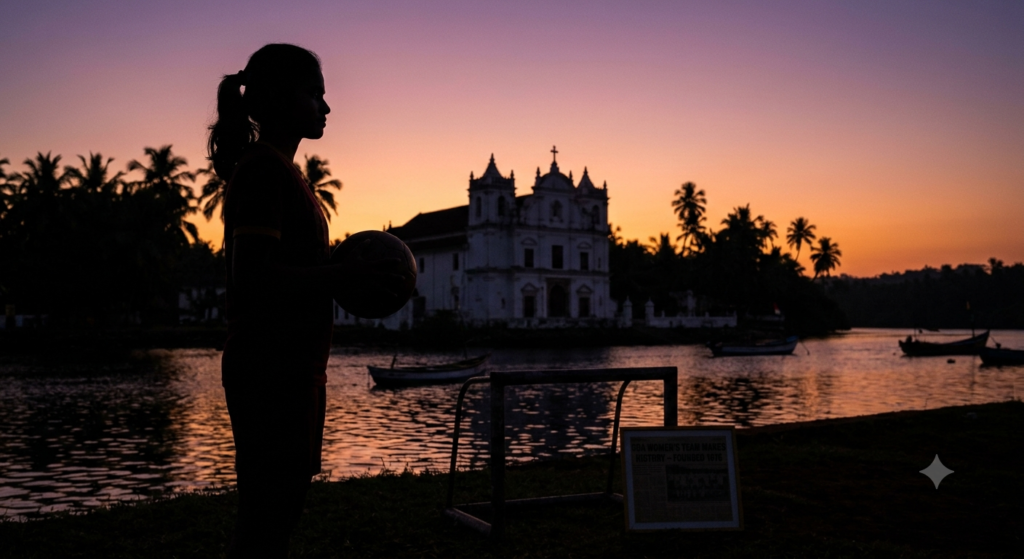
Football in Goa runs from village grounds and the Panjim Football League to the Goa Pro League, with the Goa Football Association (GFA) recognising players and coaches every year. Women have been part of this story for more than five decades.
The early years
Goan women’s football is often traced to an Adams versus Eves match at the Police ground in Panjim in 1973, though the pioneers say they were playing earlier, including a village match between Calangute and Candolim. The Goa Women’s League, with eight teams, is described as the first league for women anywhere in the country. In 1976, Goa made its debut at the women’s national championships in Sultanpur, Uttar Pradesh. That year, five Goan women were selected for the Indian team that played a visiting Swedish side: Succorinha Pereira, Juliana Colaco, Helen Fernandes, Yolanda de Sousa and Rekha Karapukar.
Among them, Yolanda de Sousa of Calangute began her career at Calangute Women’s FC and went on to play for India as a centre-forward. She scored a hat-trick for India against the visiting Swedish side in 1976 and is credited with the first international hat-trick by an Indian woman. She was the star of Goa’s national championship win as hosts in 1977, when the team scored 49 goals and beat Bengal 3-0 in the final. She scored two hat-tricks at the 1979 Nationals and repeated the feat in 1980, the year she was named Player of the Decade by the Women’s Football Federation of India. Yolanda was also part of the India team that finished runners-up at the 1980 AFC Women’s Championship in Calicut. Away from the pitch, she is an artist.
Yolanda, Juliana and Succorinha were all part of India’s squads in the early years of the Asian Women’s Cup, and played together at the national championships for the last time in 1979. Juliana later moved into administration, serving with the Goa Football Association and the AIFF Women’s Committee, and spent two years as manager of the Indian women’s team.
A new generation
The example of those players was cited in July 2018, when FC Goa launched its women’s team ahead of the second Vedanta Goa Women’s Football League. At the launch, technical director Derrick Pereira said the club hoped to build on the work of the Goan women who represented India in the 1970s.
Goan players have since returned to the national set-up. Defender Michel Castanha, from Curtorim, made her India debut at the AFC Asian Cup qualifiers in South Korea in 2018 and was part of the squads that won the SAFF Championship and the South Asian Games in 2019. In December 2020, Castanha and forward Karishma Shirvoikar were selected for the senior women’s national camp in Goa. Shirvoikar began at village club PVC Parra, plays for Kickstart in the Indian Women’s League, and has represented India at the 2026 SAFF Women’s Championship in Margao.
The latest names are already making their mark. Defender Aaroshi Govekar, from Nerul, won Best Defender in the Vedanta Women’s League 2024-25 with Sesa Football Academy (SFA) and received a call-up for India’s friendly against Nepal in Sikkim in October 2025. Pearl Fernandes scored the opening goal against Kyrgyzstan at the SAFF U-17 Women’s Championship in Bhutan, where India won the title and qualified for the AFC Asian Cup 2026. She was named women’s player of the year at the 2025 GFA awards.
The pathway to the national team
Academies and coaches are central to these journeys. SFA technical director Gavin Araujo said in October 2025 that more Goan women were reaching the national team at various age levels, which bodes well for the future of women’s football in the state.
That pathway begins at the junior level, where coaches work with young players for years before they reach the senior side. The GFA recognises this work every year at its awards, which honour players and coaches across age groups and leagues.
From the 1973 match at the Police ground in Panjim to national camps and Asian Cup qualification today, women’s football in Goa has grown alongside the rest of the game. The pioneers of the 1970s opened the way, and today’s players are carrying their story forward for the next generation.